
Cherokee Parole and Probation
Parole is conditional community release from a Georgia state prison sentence. The Georgia State Board of Pardons and Paroles decides whether parole will be granted, and the Department of Community Supervision handles field supervision after release. Probation is imposed by a court. DCS supervises state felony probation, while Cherokee Probation Services provides the local misdemeanor channel identified in county sources.
The county Jail List cannot answer either question after the person leaves custody. A sheriff release record establishes how and when the local jail stay ended. A parolee record, probation order, or supervision record establishes what followed. These records can overlap, but they are not interchangeable.
| Feature | Parole | Probation |
|---|---|---|
| Who imposes it | Georgia Parole Board after a prison sentence | A sentencing court |
| Local state supervisor | DCS Canton when assigned there | DCS Canton for felony cases |
| Local county path | Not used for state parole | Cherokee Probation Services for misdemeanor supervision |
| Starting public record | Parolee Database and GDC | Cherokee court docket |
| End record | Board discharge or later status | Court or supervising-authority discharge |
Verify Cherokee Post-Release Supervision
Identify the sentence before choosing a search. A person who bonded out may have a pending case but no probation order. A person committed to GDC may still be incarcerated. A person released from prison may be on parole, while another may have reached the end of the state sentence without parole.
- Search the Cherokee Clerk docket for the sentence, probation order, revocation, or state-prison commitment.
- Use GDC Find an Offender if the case produced a state prison sentence.
- Use the Board’s Parolee Database for post-release parole status.
- Use the TPM lookup only for a tentative pre-release review month, not proof of release.
- Match felony probation or parole to DCS; match local misdemeanor probation to Cherokee Probation Services.
- Request the originating record when the public display does not settle the status.
The Parolee Database accepts partial search terms, so compare all available identifying and sentence facts. An absence is not proof that supervision ended. The name may differ, the person may be a probationer rather than a parolee, or an agency update may not yet appear.
Note: Verify the sentence type first, because parole, felony probation, and misdemeanor probation each lead to a different official record.
Cherokee Parole Decision Records
The Georgia State Board of Pardons and Paroles controls parole decisions. A parole-eligible state prisoner is considered automatically and does not apply. General eligibility under O.C.G.A. § 42-9-45 can begin after nine months or one-third of the sentence, whichever is greater, subject to major exceptions. The Board says few eligible people are released at their first eligibility point.
A Tentative Parole Month, or TPM, marks a possible final-review month. It is not a final decision. Misconduct or unmet program conditions can postpone or cancel it. Other results include denial, rescission, reconsideration, a final release date, a parole begin date, and later revocation. O.C.G.A. § 17-10-6.1 and recidivist rules can restrict or bar ordinary parole eligibility for some sentences.
The Board publishes monthly meeting agendas and cancellation notices through its press releases. Those are Board meeting notices, not a public Cherokee courtroom hearing calendar for each person. The current notice controls because dates may be changed or canceled.
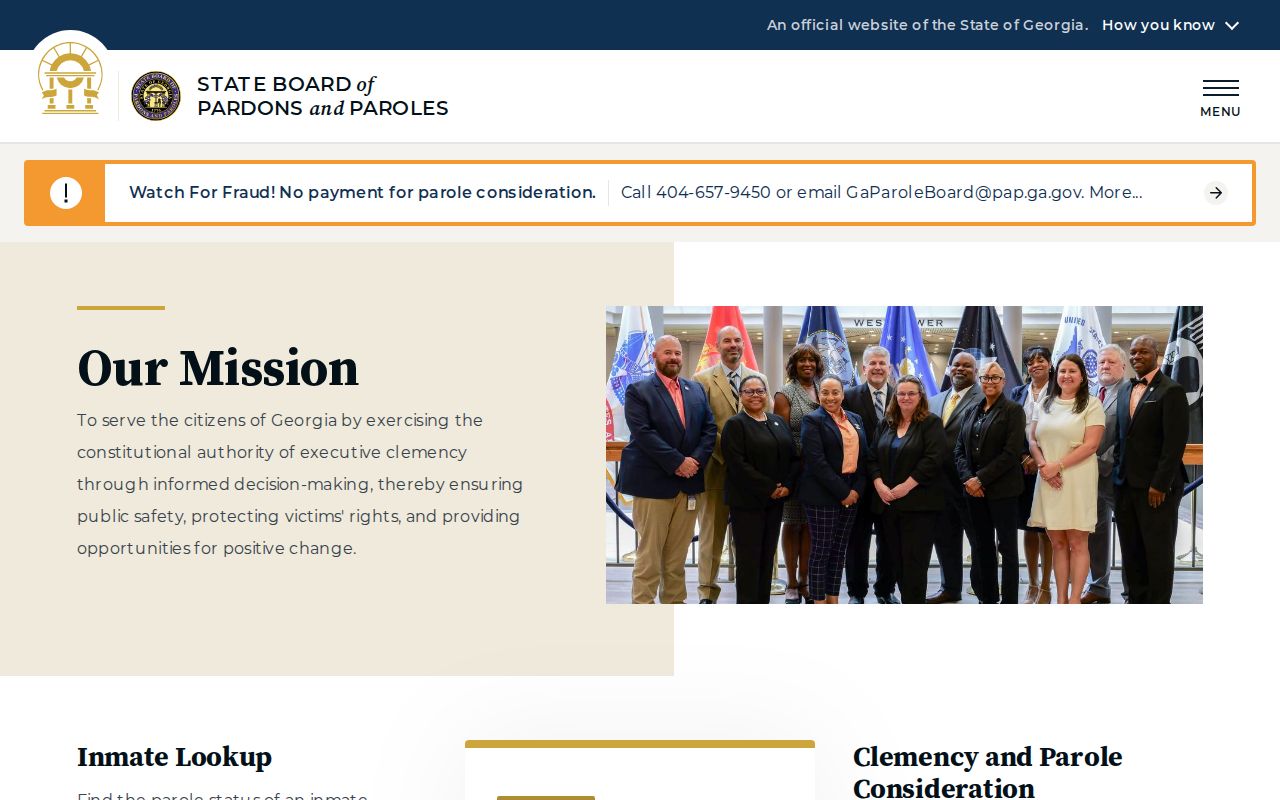
The official Georgia Parole Board homepage provides its inmate-specific search routes.
Cherokee Parole Supervision Office
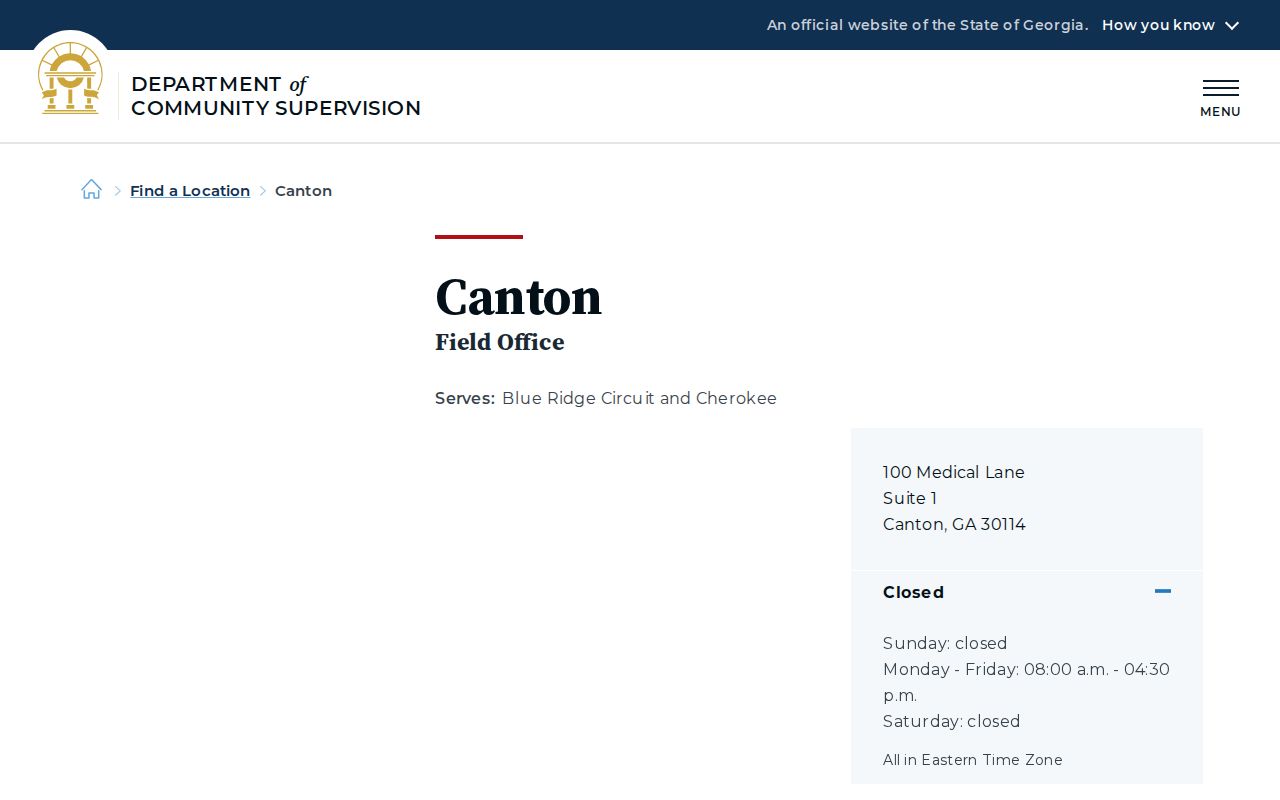
DCS Canton serves the Blue Ridge Circuit and Cherokee County. It is the local state-supervision office for an assigned parolee or felony probationer. Do not assume assignment from the address alone. Confirm it through the parole, court, or DCS record first.
Georgia DCS Canton Field Office100 Medical Lane, Suite 1
Canton, GA 30114
Phone: (770) 479-2602
Fax: (706) 558-3911
Monday-Friday, 8:00 a.m.-4:30 p.m.
The official DCS Canton Field Office listing gives those hours and contacts. Field staff supervise state cases, but the Board remains the parole decision authority and GDC remains the state custody and sentence-information agency.
Two Cherokee Supervision Offices
Cherokee County has a state and county supervision path. DCS Canton covers state parole and felony probation. Cherokee Probation Services is a county Public Services Agency division used for local misdemeanor supervision. Collapsing both into one “probation office” can send a record request or urgent question to the wrong agency.
The court order identifies the charge level and sentence. A Board or GDC record identifies state-prison and parole context. Cherokee Probation Services was established by the county in 2019 and carries a direct release-scam warning. It says the office will never ask a person or loved one for money in exchange for release from custody. Suspicious demands can be checked at 678-493-4300, option 5.
This office distinction is also important at discharge. DCS cannot certify the end of a county misdemeanor order, and Cherokee Probation Services cannot certify a state parole decision. Ask the agency that created or supervised the record in question.
Property After Cherokee Release
Release to supervision can coincide with practical jail-release tasks. The Cherokee Sheriff’s Inmate Information page says an inmate must complete a property-release form before another person can collect property. The named recipient needs government-issued photo identification, and clothing is excluded from that procedure.
Property pickup is offered Monday through Friday, excluding holidays, from 9:30 a.m. to 5:30 p.m. The property deputy’s number is (678) 493-4212. Inmate account funds are released to the inmate during normal weekday business hours, and account questions go to the Inmate Records Manager at 678-493-4209. These logistics confirm a jail release task, not parole or probation status.
A property form, fund release, and supervision order answer different questions. Keep each record. The sheriff handles property and county custody; DCS or county probation handles community supervision.
Note: Completing jail property or fund pickup does not show that parole, probation, or the underlying court case has ended.
Cherokee Release Holds and Warrants
An apparent release from the Adult Detention Center may be a transfer. The sheriff’s Warrants and Civil Unit places and releases holds with other agencies and arranges out-of-state felony extraditions. A hold is another authority’s request tied to custody. Someone can leave the county roster because another agency received the person, not because community supervision began.
Absconder is a supervision term for a person alleged to have stopped reporting or left supervision without permission. It does not describe every missed appointment, and a public search should not be used to guess. Confirm warrants, holds, revocation action, and current custody through the responsible court, sheriff, Board, DCS, or probation office.
The sheriff also warns that it does not collect or solicit payment for warrants or fines by phone or automated service. Verify any demand through a published agency number. A real warrant or hold has an official record route; a caller’s demand is not that record.
Cherokee Supervision Conditions and Violations
Conditions are the rules attached to parole or probation. They can include reporting, approved residence or travel, program participation, payment duties imposed by a court, and compliance with the law. The actual order controls. A general summary cannot establish the terms for one person.
An alleged violation can lead to review, a court hearing, changed conditions, sanctions, revocation, or return to custody. Georgia VINE can provide custody-change notifications for participating feeds, but it is not a supervision docket. Use the court or agency record to learn why custody changed.
- Parole
- Conditional release from a state prison sentence under Board authority.
- Probation
- A court-ordered community sentence under stated conditions.
- Absconder
- A person alleged to have left supervision or stopped required reporting.
- Revocation
- An authorized process that can withdraw community supervision.
- Discharge
- The formal end of custody or supervision under the controlling record.
Cherokee Accountability Court Supervision
Some released people enter a Cherokee accountability court program rather than an ordinary supervision track. The Blue Ridge Judicial Circuit describes these as voluntary alternatives to sentencing that address causes of unlawful behavior through a therapeutic approach. Available local programs include DUI Court, felony Drug Court, Family Treatment Court, Juvenile Drug Treatment Court, Parental Accountability Court, Treatment Accountability Court, and Veterans Court.
These programs are not inmate locators. Participation should be confirmed through the court case and program record, not inferred from release or a diagnosis. A person may have reporting, testing, treatment, review hearings, and other terms that differ from standard probation. The most recent court order controls.
Accountability court also illustrates why release does not mean the case is complete. The jail roster may no longer show the person, while the court docket continues to record supervision, progress, sanctions, completion, or a later change in status. Use the Clerk’s complete file when the online docket gives only a short event label.
Ending Cherokee Post-Release Supervision
Release and discharge are different. A parole begin date shows when parole started. A probation order shows when court supervision was imposed. Neither proves that supervision later ended. Look for a discharge, termination, expiration, or later court or Board action from the authority that controlled the case.
DCS Operations Support describes reentry as a path through transition, reintegration, and aftercare, with community coordinators and other services. Those resources can support a return to Cherokee County, but they are not a public release-status search. Service participation also does not establish discharge.
For the county custody and release-record path that precedes supervision, use the Cherokee County released inmates search. For state timing fields such as TPM and Maximum Release Date, the Cherokee County projected release date page explains why those dates are not interchangeable.