
BOP Inmate Locator Releases
The Federal Bureau of Prisons locator covers sentenced federal inmates whose records date from 1982 to the present. It is the right first source when a Cherokee County case or arrest led to a federal prison sentence. It is not a list of people released from the Cherokee County Adult Detention Center. Nor is it a full list of every person held for a federal matter. Federal pretrial custody can involve the U.S. Marshals Service and space in federal, state, local, or private jails before a BOP sentence begins.
A past date paired with no listed institution has a specific meaning in BOP’s record explanation. It means the person was released from BOP custody on that date. The result does not prove that all legal control ended. The person may be serving supervised release, which is court-ordered monitoring after prison, or may be held in another corrections system. A local arrest, state prison term, immigration case, or new custody event requires the matching county, state, or federal source.
Confirm a BOP Federal Release
Start with the official BOP Inmate Locator and use the identifying information the federal form requests. Open the matching record with care, then read the release date and any listed facility together rather than treating either item alone as final proof.
- Enter the identifying information requested by the official locator and review the possible matches carefully.
- Open the matching federal record. Confirm that its identifying details fit the person connected with the Cherokee County matter.
- Read the release date. If it has passed and no facility appears, apply BOP’s stated interpretation that the person is no longer in BOP custody.
- Check the relevant federal court record for supervised-release terms or later orders. Use a different custody locator if the facts point to state, local, or immigration detention.
The official locator screen shows why this is a separate federal lookup. The BOP search source is shown below.
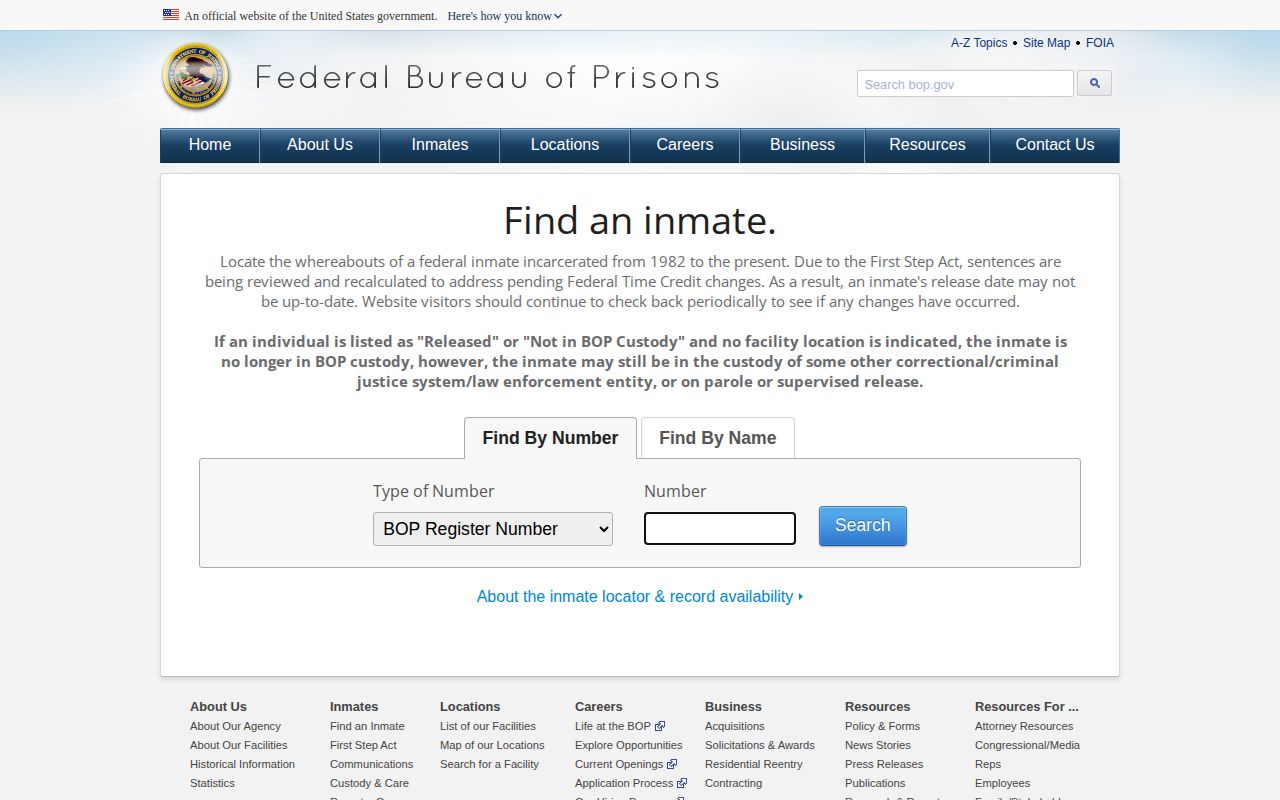
The search result must still be read in context. A BOP date answers the federal prison question, while a Cherokee County release sheet answers a county jail question.
BOP Release Record Fields
A locator result contains a compact set of facts. The release date reflects BOP’s current record, but BOP warns that First Step Act sentence reviews and Federal Time Credit calculations can cause a projected date to change. Checking again is appropriate when the date has not yet passed.
| Field | What it establishes |
|---|---|
| Facility | The BOP institution shown for present custody, when one is listed. |
| Release date | The recorded or projected end of BOP custody, subject to updates. |
| No facility with past date | BOP’s signal that release from BOP custody occurred on that date. |
Release date and supervised release are not synonyms. A prison term can end while a federal court’s supervision term continues. The locator does not replace the sentencing docket or a later court order.
Note: Recheck a future federal release date because sentence reviews and federal time credits can change the date displayed by BOP.
Read BOP Released Status
BOP publishes a separate explanation of its historic records. The agency says the locator contains federal inmate information from 1982 forward. Older federal custody may require another archival route. It also explains that a person with a past release date and no location was released from BOP custody, while warning that another correctional or justice system may still have authority over the person.
The BOP federal inmate records explanation provides the source for that interpretation.
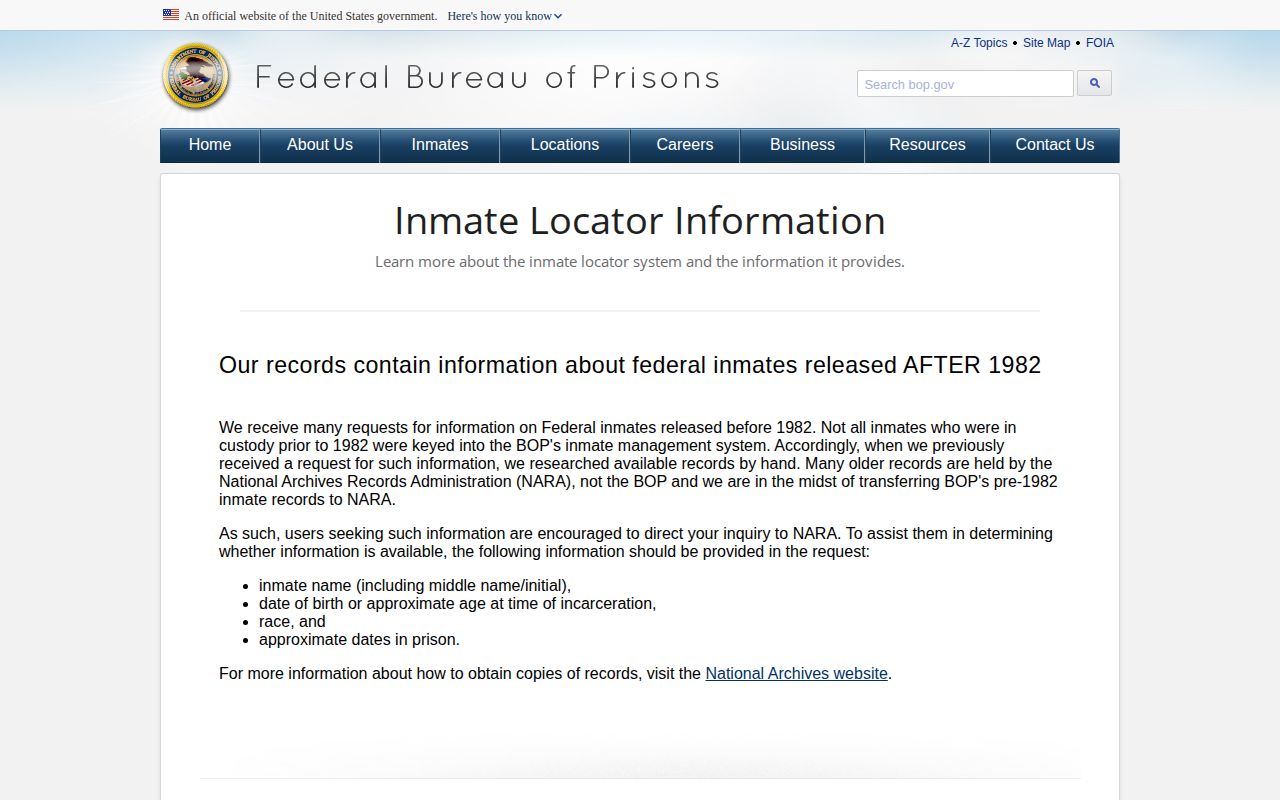
This distinction prevents a common error. A person can leave federal prison and begin supervised release, or leave one custody system and enter another. The BOP record is authoritative for its own custody but does not combine county, state, immigration, and court supervision records.
Cherokee County Federal Custody
A Cherokee County connection does not tell which agency controls the case. Someone arrested on a federal charge must be brought before a federal magistrate or judge. After that hearing, the person may be released or remanded, meaning ordered into U.S. Marshal custody while the case proceeds. USMS often houses prisoners outside BOP institutions, including in state, local, and private facilities. A pretrial federal detainee may therefore be absent from the BOP locator even while still detained.
The sequence matters. Use the federal court docket to confirm the case and release or remand order. Use USMS or the court for pretrial status. Use BOP after a federal prison sentence and for the eventual BOP release date. If the only event was a Cherokee County booking, the sheriff’s current roster, VINE, local court docket, and release record remain the correct channels. The full local path is set out on the Cherokee County released inmates search.
- Remand
- A court order placing a person in custody while the case continues.
- Supervised release
- Federal court supervision that begins after a prison term ends.
- Transfer
- Movement from one agency or place of custody to another, not community release.
- Discharge
- The end of a custody or supervision term under the controlling record.
BOP Locator Records Contact
The BOP Inmate Locator is a nationwide online records system, not a physical Cherokee County detention facility. Its official locator and records explanation are the primary public contacts for the federal release status described here. A federal court clerk holds the court file, including the judgment and conditions of supervised release. Cherokee Sheriff’s Office records cover only the local jail event and cannot certify the end of a BOP sentence.
Federal Bureau of Prisons Inmate LocatorNationwide federal inmate records
Official Inmate Locator
About Federal Inmate Records
For a narrow release check, save the date displayed and whether a facility was listed. If a formal record is needed, identify the precise BOP or court document rather than requesting an undefined federal file. A screenshot can help track a changing date, but it does not become a certified court or agency record.
BOP Release Data Limits
BOP also publishes national release statistics. Those totals describe releases across the federal prison system and do not identify a person or prove a Cherokee County custody event. They can show the scale and timing categories used by the agency, but the individual locator and court record remain the evidence for a named person.
The official BOP release statistics page is the source for those national figures and definitions.
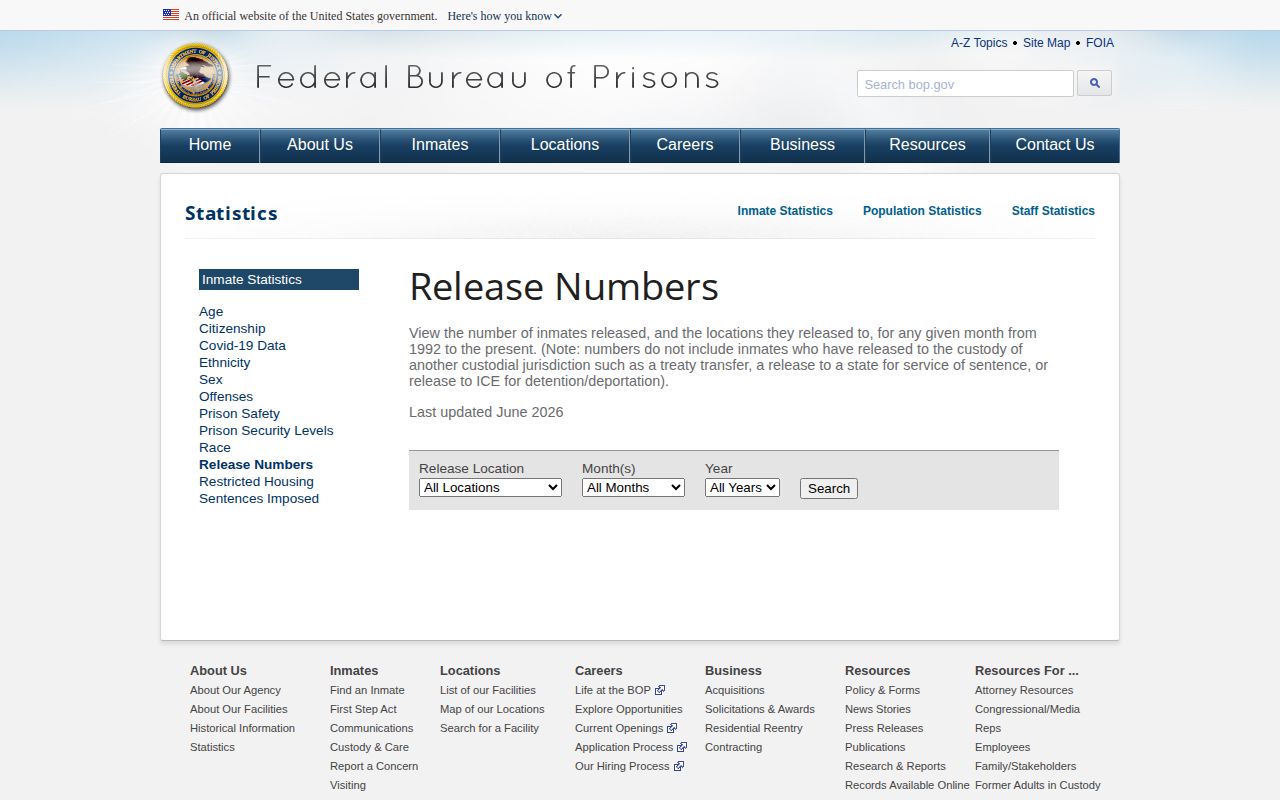
National totals should never be converted into a Cherokee County estimate. The individual locator and court record are the sound path for a named person.
BOP Release Search Fallbacks
A locator nonmatch can have several explanations. The person may have been held before trial by the U.S. Marshals Service and never entered a BOP institution. The federal record may predate the locator’s 1982 coverage, or identifying information may differ. The case also may be state or local despite a federal agency’s involvement at one stage. None of those possibilities should be converted into a claim that the person was released.
Return to the controlling record. A federal court docket can show whether the judge released the person after a hearing, ordered detention, imposed a BOP sentence, or later set supervised-release terms. A Cherokee court record can show whether the case instead produced county time, probation, or a Georgia prison commitment. Sheriff records can show a local release or transfer. ICE ODLS is the distinct path when an immigration handoff is documented. This source-by-source method takes more care, but it preserves the line between custody systems.
If the locator returns more than one person, do not select the closest name by instinct. Compare the information shown with the federal court record. Court papers identify the defendant and case in a way that may resolve the match. When a future release date changes, note both search dates and use BOP’s First Step Act warning as the reason to recheck, not as proof of a particular recalculation.
Can BOP certify a Cherokee County jail release? No. BOP can explain its federal inmate record. The sheriff maintains the county booking and release event, and the relevant court maintains the order behind that event.
Note: Keep the search date and matching court information with any saved BOP result so the federal record retains its context.
Cherokee Detainers and BOP Releases
Cherokee Sheriff’s Office publishes a dedicated Immigration and Nationality Act page describing Georgia’s 2024 HB 1105 and O.C.G.A. § 42-4-16 framework. It addresses intake procedures for aliens and foreign nationals, quarterly jailer reporting, and detainer compliance. That local framework matters when a person has both a Cherokee booking and a federal custody path.
A release from BOP custody does not certify that the person is free from ICE detention or another hold. In the other direction, departure from the Cherokee jail can be a handoff rather than community release. Confirm the end of each custody segment with the agency that controlled it, then use the receiving agency’s locator or record.
The sheriff’s immigration and detainer reporting page supplies the Cherokee County context. It is not a named-person locator, so the county release or transfer record remains necessary.