
Check Georgia Board Parole Release
Use the Board tool that matches the question. The Inmate TPM Lookup is a pre-release route. The Parolee Database is a post-release route and can supply parole begin-date context. GDC remains the official corrections route for the person’s state facility, charges, and release-date information.
- Confirm in the Cherokee court docket that the person received a state prison sentence.
- Search GDC to match the person, facility, and sentence context.
- Use the Board’s TPM lookup when the question concerns possible future parole timing.
- Use the Parolee Database when the person is believed to have been released on parole.
- Compare the parole begin date with GDC and court records.
- Contact the Board or DCS when a public record needs agency confirmation.
A partial-name search can return more than one person. Compare identifiers and sentence facts. If the Parolee Database has no match, the person may not be on parole, the name may differ, the record may lag, or another form of release may apply. A state sentence can end by discharge without parole.
Note: A county jail release sheet cannot confirm a later Board decision, even when the state sentence began with a Cherokee County case.
Georgia Parole Release Stages
Each stage answers a different question. Eligibility means the law permits consideration. A TPM indicates a tentative review point. A release date set after final review is closer to the actual custody change, while a parole begin date shows that community parole started. Revocation can later return a person to custody.
| Record stage | What it means |
|---|---|
| Parole eligibility | The sentence may be considered under governing law |
| TPM set | A tentative final-review month exists |
| TPM postponed or canceled | Timing changed because of misconduct or unmet conditions |
| Final release date | The Board set a parole release after review |
| Parole begin date | The person began post-release parole supervision |
| Revocation | Parole was withdrawn after an authorized process |
Other outcomes include denial, rescission before release, reconsideration, and a grant or denial for a life sentence. The record’s date and label should be quoted accurately. Calling every outcome a “hearing result” can mislead because individual consideration does not operate as a public Cherokee courtroom calendar.
Georgia Board Parole Meetings
The Board publishes monthly meeting agendas, cancellations, and notices on its press releases page. Those notices concern Board meetings. They are not a calendar of public hearings for each Cherokee County prisoner. Meeting dates can change, so the current agenda controls rather than a presumed recurring day.
Review the official Board agenda and cancellation notices for the current schedule.
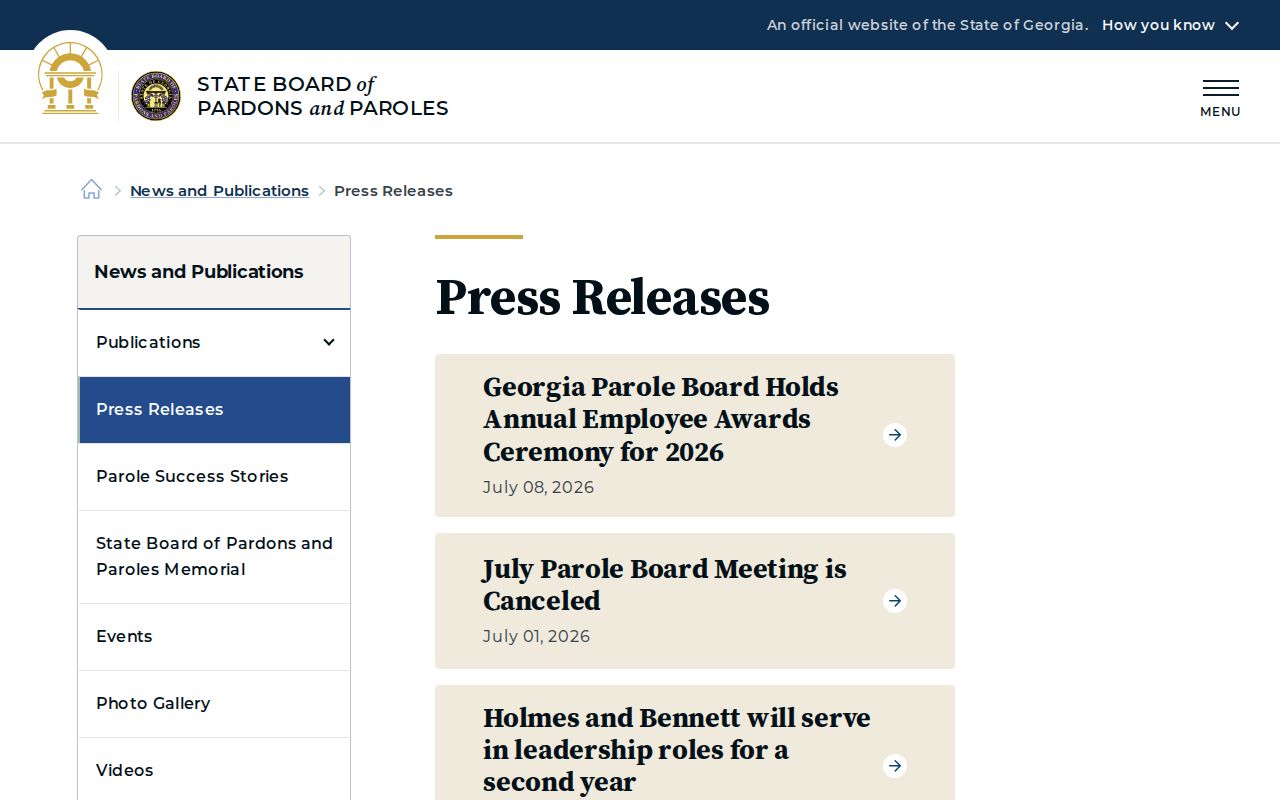
The distinction helps when a family is waiting for a parole result. A monthly agenda does not prove that a named case will be decided in public that day. Use the inmate-specific Board lookup and official record instead.
Georgia Parole Release Eligibility
O.C.G.A. § 42-9-45 supplies a general baseline for many felony sentences. Subject to exceptions, parole consideration can begin after nine months or one-third of the sentence, whichever is greater. The Board says few eligible inmates receive parole at the first eligibility date. Eligibility creates review, not an entitlement to release.
Important exclusions and special rules apply. The Board identifies non-life sentences for certain serious violent felonies committed on or after January 1, 1995, fourth-or-more felony recidivist sentences, and life without parole among categories not eligible under the ordinary process. O.C.G.A. § 17-10-6.1 governs serious violent felonies, while recidivist rules add further limits.
Life-sentence eligibility can depend on the offense and date. Board guidance identifies different eligibility periods for serious violent felony life sentences, including seven, fourteen, or thirty years for different date groups. The conviction, offense date, sentence, and current Board guidance must be checked together. One percentage or time rule cannot be applied to every Cherokee County state sentence.
Georgia Board Parole Contact
The Board’s official contact information lists a primary number and a separate public-information number for its Atlanta office. DCS, not the Board office, handles routine field supervision after release.
Georgia State Board of Pardons and Paroles2 Martin Luther King Jr. Drive SE
Suite 430, Balcony Level, West Tower
Atlanta, GA 30334
Primary: (404) 656-4661
Public information: (404) 657-9450
Send county jail release requests to the Cherokee Sheriff’s Office, and send court-file questions to the Cherokee Clerk. Use GDC for the prison custody and computation record. This routing preserves the difference between the sentence, the state incarceration, the parole decision, and supervision after release.
Note: Ask for the exact record type, since the Board, GDC, DCS, court, and sheriff each control a different part of release.
After Georgia Parole Release
DCS supervises a person released to parole. In Cherokee County, the Canton DCS Field Office serves the Blue Ridge Circuit. The field office is the local supervision route when the record shows that assignment. It is not a public list of all people released from prison, and staff may restrict case details.
| Agency | Release role |
|---|---|
| Georgia Parole Board | Considers and decides parole |
| GDC | Maintains state custody and sentence information |
| DCS Canton | Supervises state parole and felony probation locally |
| Cherokee courts | Maintain the sentence and later case orders |
| Cherokee Sheriff | Maintains county jail booking and release records |
Parole conditions are rules imposed on community release. A violation can result in sanctions or revocation. An absconder is a supervised person alleged to have stopped reporting or left supervision without permission. The current official supervision record, not an old release entry, is the right source for those later changes.
Georgia Parole Release Discharge
Parole release and parole discharge are not the same date. Release begins the community phase. Discharge ends the parole term under Board authority. A person may be out of prison yet still subject to supervision, conditions, and later status changes.
- Eligibility
- The legal point at which parole consideration may occur.
- TPM
- A tentative month for final review, not a fixed release date.
- Parole begin date
- The date post-release parole started.
- Revocation
- An authorized return from parole status after a violation process.
- Discharge
- The formal end of parole supervision.
If the original custody type is unclear, the Cherokee County released inmates search separates the county jail, GDC, parole, federal, and immigration paths. That first custody decision determines whether a Board record can answer the question at all.
Resolve Georgia Parole Record Conflicts
When records disagree, place them in time order. The Cherokee sentence comes first. GDC then records state custody and sentence computation. A TPM may appear during consideration. The Board’s final action can establish parole release, and the parolee record can show a begin date. DCS information follows the community-supervision phase.
An old TPM should not override a later postponement, cancellation, denial, or release record. Nor should an old parole begin date be used alone after a revocation. Ask the agency that created the disputed record for confirmation. GDC verifies its custody and date information, the Board verifies parole action, DCS addresses supervision, and the court authenticates its sentence.
A person released from GDC may also face another lawful custody path. A detainer is a notice or request tied to another jurisdiction’s custody. If the record points to a federal or immigration transfer, use the proper BOP or ICE system. Parole records do not prove community release when another agency received the person.
Cherokee Immigration Release Handoffs
Cherokee Sheriff’s immigration and detention reporting page explains local procedures under HB 1105 and O.C.G.A. § 42-4-16. Those procedures address booking, quarterly reporting, cooperation, and immigration detainers. A person can leave Cherokee jail custody through a handoff to immigration authorities rather than release into the community.
The Parole Board controls parole from a Georgia prison sentence. It does not decide an ICE transfer and cannot certify a county jail’s detainer entry. When the Cherokee record shows an immigration handoff, request the releasable sheriff transfer or hold record and check the ICE locator. Use the Board’s parolee search only when a state parole record actually exists.
This distinction also protects the parole timeline. A TPM, parole grant, or parole begin date answers a state sentence question. It does not cancel a separate detainer. Read the newest Board, GDC, sheriff, court, and immigration records in sequence before concluding that the person entered the community.