
Georgia DOC Release Records
The Georgia Department of Corrections Find an Offender gateway is the official state route for people in GDC custody. GDC says the tool can help locate an inmate and provide more information about charges, facility location, and release date. It also warns that offender photos display automatically when available.
This is not a Cherokee County jail roster. A person booked at the Adult Detention Center may bond out, serve county time, receive probation, or transfer to GDC. Only the last path makes the statewide prison search the main custody record. The Cherokee court docket supplies the sentence and commitment context, then GDC supplies the state custody and release information.
Search Georgia DOC Releases
Start with enough detail to distinguish people who share a name. A booking ID from Cherokee is not necessarily the same as a GDC identifier. Compare the court case, charge, sentence, and available identity details before treating a result as the correct person.
- Use the Cherokee Clerk docket to confirm that the case produced a state prison sentence.
- Open GDC Find an Offender and follow the official Search Now route.
- Enter as much available information as possible, including name and a GDC ID when known.
- Compare the facility, charges, photograph, and release-date fields with the court record.
- For parole timing, check the Board’s TPM lookup; for release to parole, check the Parolee Database.
- Request written verification from GDC when the date or status must be confirmed beyond the online display.
A current GDC facility shows state custody. A date in the record needs context: it may be a computed maximum release date, another release field, or a date affected by later action. The Board’s Tentative Parole Month is different. It is a review month, not a promised release day.
Note: Search by the state identifier when available, since a county booking number and a GDC number serve different record systems.
Georgia DOC Release Search Fields
GDC directs users to enter as much available information as possible and describes the tool as a source for facility, charge, and release-date information. The live application may change labels. Read all displayed fields together and retain the Cherokee sentencing record as the link between the county case and state custody.
| Field or detail | What it helps confirm |
|---|---|
| Name and GDC ID | Identity within the state corrections system |
| Facility location | Whether and where GDC lists current state custody |
| Charges | Comparison with the Cherokee court sentence |
| Release date | State sentence or release timing shown by GDC |
| Maximum Release Date | Computed end-date context for a state sentence |
| Photograph, if available | Identity check within the GDC record |
The online record is an official lead, not a certified guarantee. GDC expressly tells users to verify information before assuming it is complete. A later court amendment, jail-credit correction, disciplinary action, or other authorized change can affect the date.
Verify Georgia DOC Discharge
GDC’s disclaimer gives a clear written-verification route. It identifies Inmate Records and Information at P.O. Box 1529, Forsyth, GA 31029. GDC’s general mail address is 300 Patrol Road, Forsyth, GA 31029, and the state lists (404) 656-4661 for inmate concerns or questions. A focused request should identify the person and ask for the exact state custody or release fact needed.
Georgia Department of CorrectionsInmate Records and Information
P.O. Box 1529
Forsyth, GA 31029
Questions: (404) 656-4661
If the online computation conflicts with the Cherokee sentence, GDC advises that the incarcerated person may speak with a counselor and use the grievance process. Some errors also require contact with the clerk in the county of conviction, especially when jail credit or the sentencing document is at issue. The Frank C. Mills III Justice Center retains the complete Cherokee court file.
Georgia DOC Search Gateway
The official gateway displays the terms and warning that govern use of the statewide tool. View the GDC offender search gateway and disclaimer before following the search link.
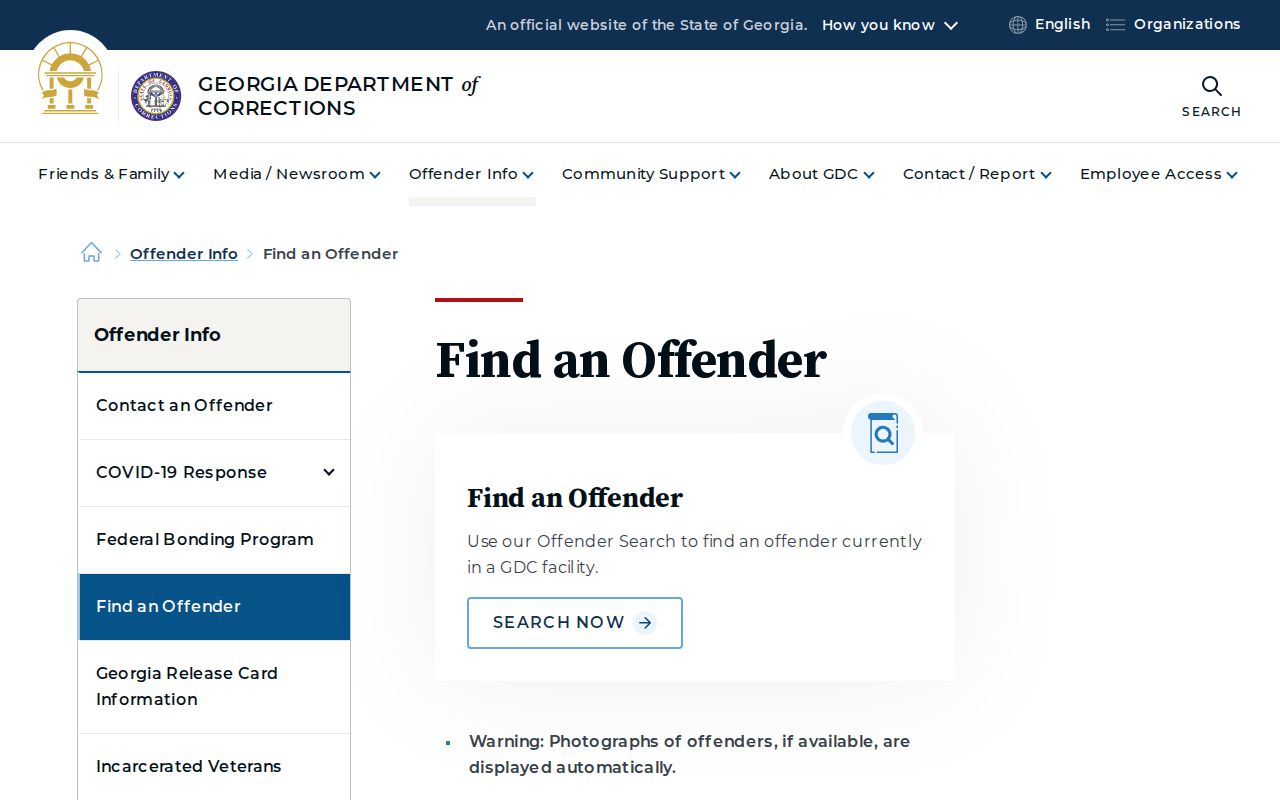
The warning matters after release. Online details can be incomplete, and the state asks for written verification. A screenshot should be treated as a view of the portal at one point in time, not as a substitute for the originating state record.
Georgia DOC Release Dates
Georgia Rule 125-2-4 defines sentence-computation concepts. A sentence begin date can reflect jail time served or special court instructions. The sentence end date adds the maximum sentence length while accounting for non-running time and earned-time credits. The Cherokee judgment and jail-credit entries therefore remain important after a person enters GDC.
| Date term | Meaning |
|---|---|
| Sentence begin date | Starting point that may incorporate authorized jail credit |
| Sentence end date or MRD | Computed maximum end of the state sentence |
| Tentative Parole Month | Board review month that can change or be canceled |
| Parole begin date | Post-release evidence in the parole record |
| County jail release date | Local jail departure recorded by the sheriff |
The GDC Performance Incentive Credit program may reduce a TPM or MRD for an eligible offender. GDC says eligible people can earn up to twelve points and potentially receive one to twelve months off. Several categories are excluded, including short sentences, minimum-mandatory or non-parole-eligible offenses, and life sentences. Do not assume the program applies to a named person without an official record.
Georgia DOC Parole Release
The State Board of Pardons and Paroles controls parole decisions. The Board’s TPM lookup reports a Tentative Parole Month for the pre-release review path. The Board says that month is conditional on good conduct and may also depend on program completion. Misconduct can postpone or cancel it.
After release to parole, the Parolee Database is more useful than the pre-release TPM result. DCS then performs field supervision. A person living under supervision in Cherokee County may be linked with the Canton DCS Field Office, but assignment should be confirmed from the parole or DCS record. The county jail does not control either the Board decision or the DCS supervision status.
General parole eligibility under O.C.G.A. § 42-9-45 does not create a release date. Many felony sentences reach consideration after nine months or one-third of the term, whichever is greater, unless another rule applies. Serious violent felony, recidivist, minimum-mandatory, and life-sentence rules can change or bar eligibility. The Board notes that few people receive parole at their first eligibility date.
Note: A Tentative Parole Month is a review marker, while a parole begin date reflects a release that has actually occurred.
After Georgia DOC Release
A person can leave GDC in several ways. Release may be to parole, discharge at the end of a sentence, or transfer under another lawful authority. Parole keeps the person under state supervision. Discharge means the controlling custody or supervision term has formally ended. A transfer means custody continues elsewhere.
- GDC custody
- State prison custody under the Georgia Department of Corrections.
- Parole
- Conditional release from prison under Board authority and DCS supervision.
- MRD
- Maximum Release Date, a state sentence-computation term.
- TPM
- Tentative Parole Month, a changeable Board review month.
- Detainer
- A request or notice tied to custody by another jurisdiction.
For a Cherokee County case, use the court docket to learn whether departure from the local jail was a GDC commitment. Use GDC to confirm state custody and release information, then use the Board and DCS for parole. Federal BOP and ICE records are separate. The Cherokee County released-inmate search path lays out those custody branches when the starting system is uncertain.
Correct Georgia DOC Release Errors
A release-date conflict should be traced to its source. First compare the Cherokee sentencing order with the jail-credit entry and GDC display. GDC’s loved-ones guidance says an incarcerated person may speak with a counselor about time that appears incorrectly computed and may use the grievance process if the matter is not resolved. The county clerk may need to address missing or incorrect sentencing paperwork.
Write down the exact field, date, and document that conflict. A court can authenticate its own order, while GDC can explain its computation record. The Board can address a TPM or parole decision, and DCS can address supervision after release. One agency should not be asked to change a date owned by another. A clear record trail also helps distinguish a true calculation issue from a portal update delay.
If GDC no longer shows a current facility, do not assume all legal control ended. Check for parole, discharge, another jurisdiction’s detainer, or a later court order. The newest official record should control the current conclusion.
Cherokee Immigration Release Handoffs
The Cherokee Sheriff’s immigration page explains local procedures under HB 1105 and O.C.G.A. § 42-4-16, including booking, quarterly reporting, cooperation, and detainer compliance. A person can leave the county jail because immigration custody took over. That handoff is not a GDC prison discharge and does not prove release into the community.
GDC Offender Search applies when a Cherokee court imposed a Georgia state prison sentence. If sheriff or court records show an immigration detainer instead, request the releasable county transfer entry and use ICE’s locator for federal immigration custody. A missing GDC facility cannot resolve an ICE transfer, just as an ICE result cannot certify the end of a Georgia prison sentence.