
Sheriff Headquarters Release Routes
Cherokee Sheriff’s Office Headquarters shares the 498 Chattin Drive campus with the Adult Detention Center. It is the local routing point when a current Jail List search no longer answers the question. The sheriff’s records process can locate a booking and release sheet. Bond Administration explains financial release paths. Warrants & Civil handles holds and extradition work. Jail contacts address property, account funds, mail, and operational details. Each unit holds a different part of the release story.
A person may leave the Cherokee jail through bond, time served, sentence completion, dismissal, or a release to probation. The person may instead move to GDC, another county, a federal custodian, or ICE. The sheriff record can identify the local departure, but the next agency controls later status. That difference is central. “Released from Cherokee custody” does not always mean released from all custody.
The public Jail List confirms only a limited set of current fields: inmate ID, booking ID, name, booking date, and arresting agency. It does not expose a verified public release date or release reason. Headquarters records staff are therefore the local fallback when a family member, attorney, or other requester needs the end of the booking event rather than proof that the booking once existed. Georgia VINE and the court docket can supply fast supporting clues while that request is pending.
Court type helps route the supporting check. Magistrate Court handles initial appearance and bail hearings for people booked into the Adult Detention Center. State Court handles misdemeanor and traffic criminal cases, while Superior Court handles felonies. A docket may explain a bond, dismissal, sentence, probation term, or GDC commitment, yet it does not replace the sheriff’s entry for the time physical jail custody ended. Reading both sources prevents a court ruling from being mistaken for the completed release process.
| Question | Headquarters route |
|---|---|
| Exact release date, time, or reason | Sheriff Records and an open-records request |
| Bond type or payment process | Bond Administration plus the court docket |
| Hold, clearance, or extradition | Warrants & Civil and the receiving agency |
| Property or inmate-account funds | Property deputy or inmate records manager |
| Case result after release | Cherokee Clerk of Courts |
Confirm Sheriff Release Records
Start with the official Cherokee Jail List. It searches current custody by name and publishes fields such as inmate ID, booking ID, name, booking date, and arresting agency. The list does not publish a verified recent-release archive. Its disclaimer also says information changes quickly, may be updated periodically, and may contain errors. Absence can point to a release, but it can also reflect a transfer, hold handoff, spelling issue, or update lag.
When the person is absent, preserve the known booking facts and move through the local confirmation chain.
- Check Georgia VINE for a custody status change or prior release alert.
- Search the Cherokee court docket for bond, dismissal, sentence, probation, or commitment entries.
- Call Sheriff Records if the office can route the requested release item.
- Submit a narrow written request for the booking and release record.
- Follow any documented transfer to GDC, another county, BOP, USMS, or ICE.
The sheriff’s headquarters and jail contact page identifies the campus and main contact.
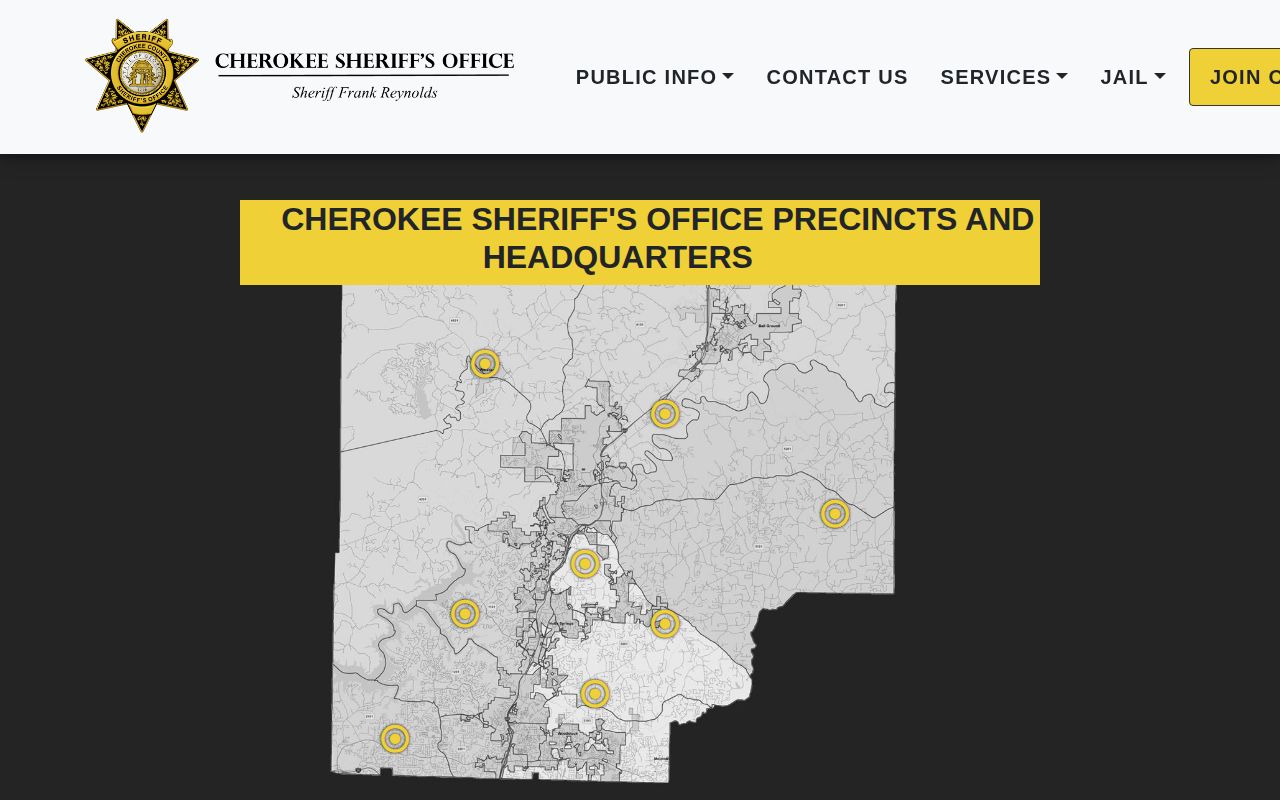
That official contact source helps route the request, while the actual document remains the best evidence of the local custody event.
Sheriff Release Records Contact
The sheriff’s main number is 678-493-4200. Sheriff Records lists 678-493-4140 for incident reports, Monday through Friday from 8 a.m. to 5 p.m. These lines can help identify the right unit. A written request is better when an exact date, time, release type, transfer entry, or hold record is sought because it creates a clear description of the requested public record.
498 Chattin Drive
Canton, GA 30115
Main and jail contact: 678-493-4200
Sheriff Records: 678-493-4140
Records hours: Monday-Friday, 8 a.m.-5 p.m.
The Sheriff Records and Open Records page cites the Georgia Open Records Act and links to the county’s NextRequest portal. Ask for the releasable booking and release sheet for a named person. Include the booking ID and date if known. List the precise fields needed: release date and time, release reason, bond or transfer entry, hold-release entries, and the destination named in a transfer record.
Public access is subject to exemptions and redaction. The sheriff says that a withheld record will be tied to the Georgia provision that exempts it. No sheriff-specific release-record fee schedule appears on that page. If a search may be extensive, request a cost estimate before the office begins billable work.
Note: A focused request gives records staff a defined booking event and reduces unrelated review, delay, and redaction.
Sheriff Release Logistics
Bond Administration covers the financial path out of local jail custody. Cherokee documents cash bonds, card payment through its listed online provider, professional bondsman bonds, property bonds, and approved property bonds from another county. A $20 state-required fee applies to the bond routes described by the sheriff. Online payment also has a $10 automation fee and a 5 percent administrative fee. The sheriff says a bonding company may charge 15 percent or at least $50 per bonded charge or offense. A bond guarantees a court appearance; it is not a fine or final case outcome.
Property and funds follow set local rules. An inmate must complete the property release form before the named person can pick up eligible belongings. Clothing is excluded from that procedure. Pickup runs on weekdays, excluding holidays, from 9:30 a.m. to 5:30 p.m., and the recipient must show valid government photo identification. The property deputy is reached at 678-493-4212.
Funds in an inmate account are released to the inmate during normal weekday business hours from 8 a.m. to 5 p.m. The inmate records manager’s number is 678-493-4209. After release, scanned mail remains available through the commissary services provider, while new mail received by the jail is returned to the sender. These details answer practical follow-up questions, but the release sheet and court order explain why custody ended.
- Bond
- A financial guarantee of court appearance, not the end of the case.
- Release record
- The jail entry stating when and how its custody event ended.
- Receiving agency
- The office that takes custody after a transfer.
- Detainer
- A request or basis for another agency to hold or receive a person.
Sheriff Detainer Release Records
The Warrants & Civil Unit places and releases holds with other agencies. It also arranges felony extraditions from outside Georgia. As a result, the end of a Cherokee hold may coincide with the start or continuation of custody somewhere else. Ask for releasable entries that show when the local hold cleared, whether a transfer occurred, and which agency received the person. Then use that agency’s own official system.
Immigration custody has a county-specific layer. The sheriff’s Immigration and Nationality Act page discusses Georgia’s 2024 HB 1105 framework, intake procedures for aliens and foreign nationals, detainer compliance, and quarterly jailer reporting. It is not a person search. It explains why a local roster departure may be a handoff rather than a community release.
The official sheriff page shows the local immigration reporting and detainer context.

When the record indicates ICE involvement, check the federal detainee locator and keep the local sheriff transfer entry as the source for departure from Cherokee custody.
Note: Describe a handoff as release from Cherokee custody unless a later source confirms release into the community.
Sheriff Restricted Release Records
Record restriction is a process separate from release. The sheriff’s local page explains Georgia’s O.C.G.A. § 35-3-37 process for certain criminal history records. For arrests before July 1, 2013, an applicant generally starts with the arresting agency, which may charge no more than $50 to process the application. If required after approval, a $25 GBI processing fee is sent with the approved material to the Georgia Crime Information Center.
For arrests on or after July 1, 2013, the sheriff explains that there is no application process and that a prosecutor may approve restriction at sentencing, with sentence-completion approval noted in material sent to the court. Eligibility and the effect of restriction depend on the record and legal process. Restriction should not be described as erasing every jail, court, or public source. The sheriff itself warns that information may remain available outside GCIC control.
The Cherokee record-restriction page shows the local procedure and the split by arrest date.
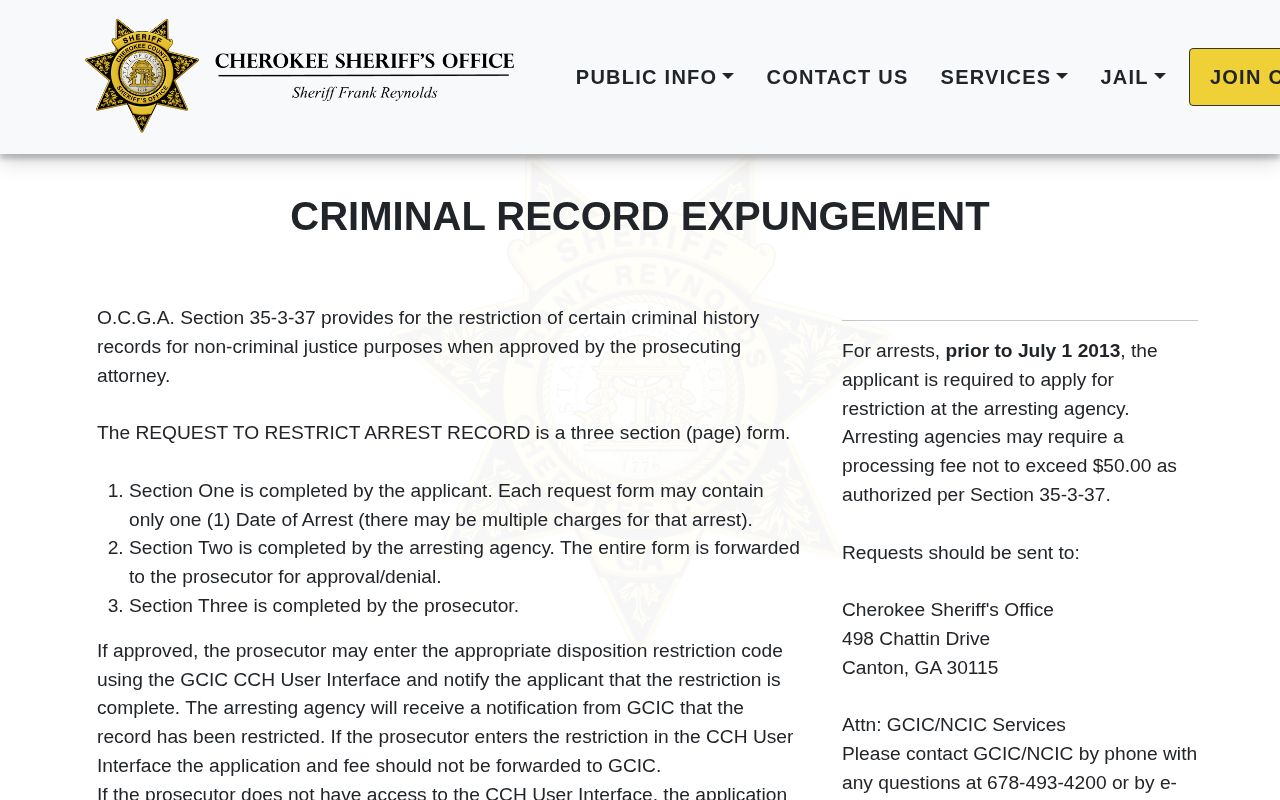
This process can affect access to some criminal-history data, but it does not substitute for confirming the original release or court disposition.
Sheriff Jail Accreditation Record
The headquarters campus also contains the Adult Detention Center, whose official accreditation history provides precise local context. The sheriff reports participation in ACA, NCCHC, and PREA processes. NCCHC compliance has been earned through each three-year audit cycle since 2004, and reaccreditation was awarded in April 2023.
The office reports first ACA accreditation in August 2019, later Triple Crown status, and a perfect score in the April 21-23, 2025 ACA reaccreditation audit. The next ACA audit is listed for April 2028. Those facts identify the jail operation connected to headquarters. They do not verify any person’s release, which still requires the booking record, court entry, or next-agency record.
For a detailed county-jail custody path, the Adult Detention Center release page explains how the Jail List, VINE, court file, and transfer systems fit together.